
Heating Up: Smith & Wesson
Posted by Cory Ross on Jul 23rd 2024
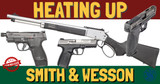

Smith & Wesson is one of the oldest gun makers in the United States. Their beginning dates to 1852 and have been a stalwart within the gun industry since. Fast-forward to today Smith is known for much more than the wheel guns that built their legacy. Smith builds a host of firearms that cover almost every niche within the community. From ARs to Service Stock Revolvers and everything in between, Smith has listened to its fanbase to expand its lineup. This July, Smith has gone all in with a host of new products. It’s a bit difficult to track so I’ve decided to list the new models in one article, rather than blast the reader. These new releases represent line continuations and new standards within the industry. Enjoy.
Model 1854
The continuation of the 1854 line was expected as Smith & Wesson released the lever action rifle in the venerable 45 Colt cartridge. The features and cosmetic choices of the 44 Mag iteration hold over in the new cartridge offering. The gun can be had in either checkered walnut or synthetic M-LOK furniture and an Armornite or stainless-steel finish respectively. Capacity remains the same at 9 rounds. While the 45 Colt is a capable cartridge, I find it odd that the 357 Magnum/38 Special wasn’t the next release (or the original chambering, for that matter). The synthetic stock model will sell for $1179.99 while the walnut version will be priced at $1299.99.
SD40 2.0
This is another continuation product release and one that was half-expected. The SD9 2.0 is a marked upgrade over its predecessor, the SD9VE, which was also chambered in 40 S&W. So, it makes sense that Smith would introduce the newer gun in the 10mm lite cartridge. Besides caliber, the feature set remains the same: a new trigger design, more slide serrations, and compatibility with former SD series accessories. The pistol ships with one 14-round magazine. The street price is $299.99.
M&P9 Shield Plus Threaded
This release follows a trend of other pistol manufacturers. While many might not think that a threaded barrel on a handgun dedicated to concealed carry is optimal, many have drawn to it. Why? Flexibility. When most shooters think of threaded barrels, they quickly gravitate to suppressors. It’s common sense. However, I’m not sure that’s what people will use it for in this instance. Recoil management is the name of the game when it comes to shooting. Smaller guns, due to their lower mass, generally create more felt recoil compared to their bigger and heavier brethren. A compensator is a tool that can be used to help reduce muzzle flips and create a linear recoil that’s easier to control and allows for quick and more accurate follow-up shots. A threaded barrel in a compact carry gun begs for a compensator. And with more companies going to this (think the Springfield Hellcat RDP or the new Glock 43X MOS with threaded barrel), it’s not surprising that Smith is following suit.
Otherwise, the gun has all the features of the standard Shield Plus: night sights, optics ready, 10, 13, and 15-round capacity (depending on the magazine combination the gun ships with), enhanced grip texture, and a flat-face trigger. Currently, this iteration is only offered in 9mm. Therefore, the thread pitch on the barrel is 1/2x28. Street price is around $479.99.
Smith & Wesson M&P Carry Comp Series
From Smith & Wesson: “Continuing to pursue excellence and performance, the new Performance Center M&P Carry Comp pistols focus on enhancing the shooting experience. Strategically designed to leverage the gasses escaping the end of the gun during firing, the Carry Comps helps reduce felt recoil meaning you can stay on target better. The perfect bridge between big gun performance in a small carry pistol.” These pistols blend Carry Optics division guns (from USPSA) with aspects of Open Division pistols to create a balanced and enjoyable shooting experience. Like Sig Sauer, and recently Springfield, Smith & Wesson has added porting at the muzzle of the slide without the need to attach a comp via a threaded barrel. This eliminates the inconvenience of removing the comp whenever the pistol is field stripped. Smith & Wesson has gone a step forward and developed porting that diverts gasses away from your optic to maintain an unobstructed sight plane (dubbed ClearSight, how original).
This concept comes in three flavors from Big Blue: The M&P9 M2.0 Metal Carry Comp, the M&P9 M2.0 Compact Carry Comp, and the M&P9 Shield Plus Carry Comp. The Metal as the name implies uses 7075-T6 aluminum to construct the frame, bringing the pistol to 28.1 oz. With the heft of the frame coupled with the porting on the slide, the M&P 2.0 Metal Comp will deliver the softest recoil impulse of the models introduced. Of course, that comes at a concession. This gun will not be in your everyday carry rotation. Instead, it will live as a range or competition piece.
The M&P 2.0 Compact Carry Comp version may be the most practical of the bunch. It combines all the features of the M2.0 Compact but adds recoil-reducing compensation. At a weight of 25.4 oz, this gun might work its way into serious duty use. A bit big for concealed carry, however many shooters might utilize this pistol for that capacity.
The Shield Plus version of the family is optimized from the ground up for concealed carry. This is also where a compensator is most beneficial. Small, carry handguns are generally harder to manage under recoil. They are lighter and possess less mass. Adding porting on the slide will mitigate the vertical muzzle rise and increase performance.
A couple more notes about this family. All the pistols are optics-ready, which should be a standard feature in 2024. The M&P Metal and Compact will utilize plates while the Shield is the (now) standard RMSc or Romeo Zero footprint. Moreover, each model has a blacked-out rear sight and a tritium-filled front sight. Also, unlike Springfield and Sig Sauer, Smith has gone for full-length barrels that are ported. The others have gone with shorter barrels housed in the compensated slide. Pricing is as follows—$949.99 for the Metal, $749.99 for the Compact, and $599.99 for the Shield Plus.
Final Thoughts
A lot of new products have been introduced this year. But it’s not surprising. After several years of a Bull Market, things have saturated. Companies now must expand their offerings to gain buyers’ attention. This release wave represents a manufacturer doing that. For Smith, they are chasing other giants within the industry. For many people, it comes down to Ford vs. Chevy. Everyone is making a similar offering (compare the Carry Comp Shield the Sig Macro and now the Ported Hellcat, and the Shadow Systems CR920P), so it comes down to personal allegiances to which a consumer will choose. All models are shipping by the time you are reading this article.

Featured Products

SPRINGFIELD ARMORY
Springfield Armory Echelon Gear Pac 9mm 4.5" Barrel 17/20-Round Viridian RFX11 4 Mags
At the core of the Echelon is the Central Operating Group, a serialized fire control system that can be easily removed and installed into different grip modules. This modular chassis increases...

DANIEL DEFENSE
Daniel Defense DDM4A1 RII 14.5" 5.56 NATO AR Black 30 Round
The DDM4A1 RII is designed as a dependable, duty-ready AR-15pattern rifle built around a fully ambidextrous lower, allowing operation of the bolt catch, safety selector, and magazine release from...

ZRO DELTA
ZRO Delta Ready Series V2 .223 Wylde 16" Barrel 30 Round
The Ready Series AR-15 Rifle is the foundational offering of the Ready Series. It combines all of the durability and reliability the Ready Series is known for with streamlined features. Featuring a...

GFORCE
GForce 1911 A1 US ARMY 45ACP 5" Barrel 7 Round
GForce 1911 A1 US ARMY 45ACP 5" Barrel 1 - 7 Round Magazine, Black Nitride Frame and Slide, Ambi Thumb Safety, Extended Grip Safety, Brown Grips MGE Exclusive. Specifications and Features: Caliber...
SMITH AND WESSON
Smith & Wesson Equalizer 3.675" 9mm OR (1)10(1)13 (1)15 Bundle w/ Viridian RFX 11 Savior Bag
Unleash your potential with our most advanced micro-compact yet. The EQUALIZER redefines concealed carry with next gen EZ technology, minimal recoil and adaptable magazine capacity all in a sleek,...
Z-MAN
Z-Man Shad FryZ
Rig a Z-Man Shad FryZ for crappies, panfish, trout, perch, and more species using micro finesse applications, and let this 1.75-inch fry imitator do its thing! Shad FryZ is a bite-sized swimbait that...

PFLUEGER
Pflueger President Spinning Reel 5.2:1
The Pflueger President Spinning Reel continues to lead the way in performance and value. The many Pflueger President sizes make them an excellent choice for anglers who want a high-quality...

ARIAT
Terrain Wide Square Toe Steel Toe Work Boots, Destressed Brown
ATS technology provides lightweight support that helps your foot adapt to uneven surfaces for lasting comfort and stability Gel-cushioned insole with heel stabilizer helps provide lasting comfort...

MUCK
Muck Women's Realtree Edge Woody Max Boots
For dedicated hunters, Muck Woody Series Women's Hunting Boots are packed with features to keep you protected on the move. The MS2 bobbed molded outsole of these women's hunting boots is designed to...

BROWNING
Browning Buckmark Slim Flipper Knife 3.13" D2 Black Drop Point Blade, Black Polymer Handles Liner Lock
The Buckmark Slim has all the features necessary to be your ideal everyday carry knife. First and foremost, it was designed with a skeletonized internal frame and tough polymer handle scales that...

DAIWA
Daiwa Kage Casting Rod 7'1" Medium Power Xtra Fast Action
We obtained the new Daiwa Kage casting rod, the KAG711MXB “Light Jig & Texas”, to be precise. This stick is a 7’1” medium power, extra-fast action rated for lures from 1/4-3/4. We got this model...

LELAND LURES
Leland's Lures Eyehole Round Jighead 1/32oz- Pink
Specifications and Features: Eyehole Round Jighead 1/32oz- Pink